





Like much of the design for Roper Hospital Medical Center, the interior design approach celebrates the community it serves. Rather than bringing a preconceived design to the project, the team investigated what would speak to the identity of the South Carolina Lowcountry. Mockup spaces allowed the public to experience the intention of the new facility. Engagement with community leaders from the Roper St. Francis Board of Directors provided invaluable feedback to what was most important in the space. The finishing touch will see the design unified through artwork by local artisans to directly reflect the rich culture of the Charleston area.
E4H Creative Director of Interior Design Andrea Kingsbury brings 20 years of healthcare design expertise to the design of this facility, but the unique approach to this project made a distinct impression.
“This project truly put the community at the center of the design,” she said. “That was a first in my career and has been incredibly rewarding.”
The result is a modern, Lowcountry-inspired interior palette that feels inherent to the surrounding landscape. Textures and materials inspired by the region’s flora, fauna, and native environment are purposed for those who will interact with the space.
Upon Entry, a Breath of Fresh Air
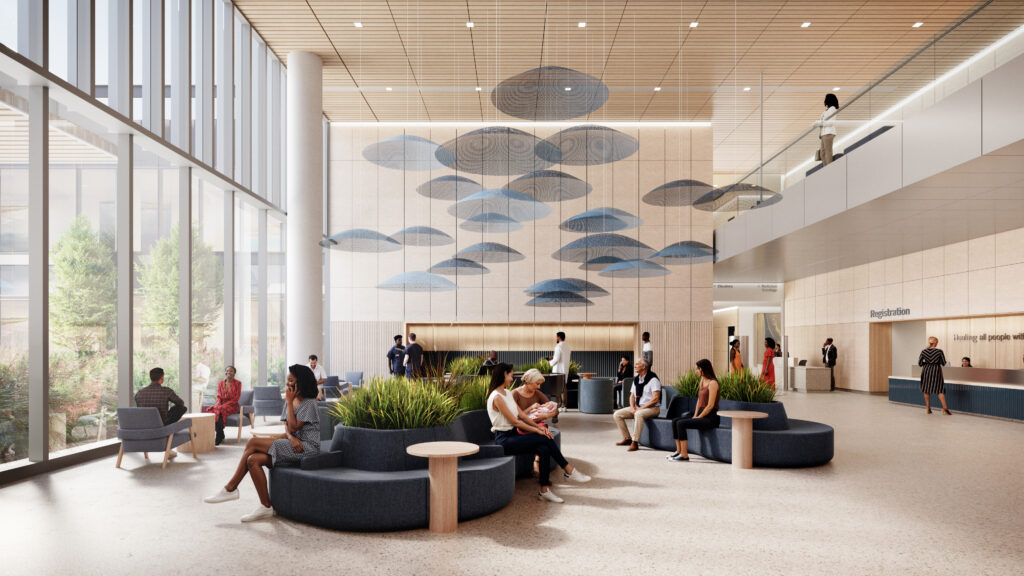
The regional aesthetic shines in the double-height entrance lobby, where expansive daylighting, limestone feature walls, and terrazzo flooring reflect the region’s rich landscape. The space evokes the comforts of a hotel, with an information desk that serves as a compass for visitors.
From north to south, the waiting area connects to the cafe and healing garden. From east to west, the patient tower flows toward the connected parking garage. A wide circulation path guides visitors between amenities, including a pharmacy, grab-and-go conveniences, and an art gallery with exhibits from Roper St. Francis Healthcare’s history.
Art as a Connecting Thread
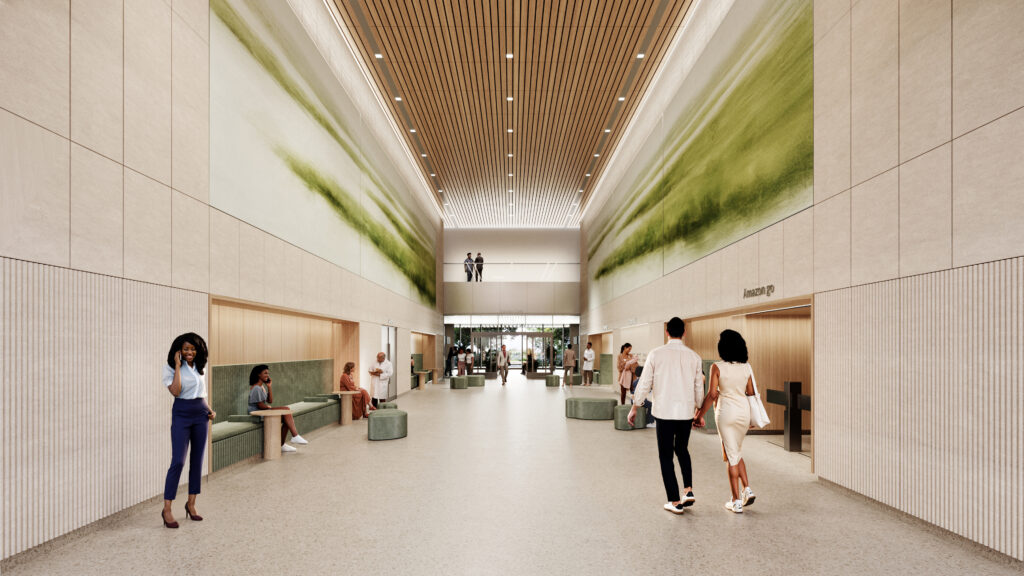
Artwork is abundant throughout the facility, infusing treatment and transitional spaces alike with pieces inspired by the Lowcountry’s tranquil atmosphere.
“The design intent is that the art be driven by local artists,” said Kingsbury. “When you walk into a space, instead of the art being a re-creation of someone’s impression of the area, it’s created by someone who lives and breathes the community.”
The design team modeled the conceptual renderings with murals that stretch down the length of the promenade, from the lobby’s circulation desk to the garden café at the end of concourse, after the work of a local artist. Ultimately, the facility will showcase different artists for key pieces, turning the work of a diverse cohort of creators into a conceptual driver for the building.
The building’s art isn’t limited to paintings, murals, and wall prints. Suspended sculptural pieces—composed of a lightweight, free-floating material inspired by the culture at large—provide a wayfinding point for visitors and act as a beacon for newly arriving users. Beyond acting as dynamic artwork, these sculptures will also balance the voluminous scale of the space with a light touch.
Furniture That Provides Privacy and Connection
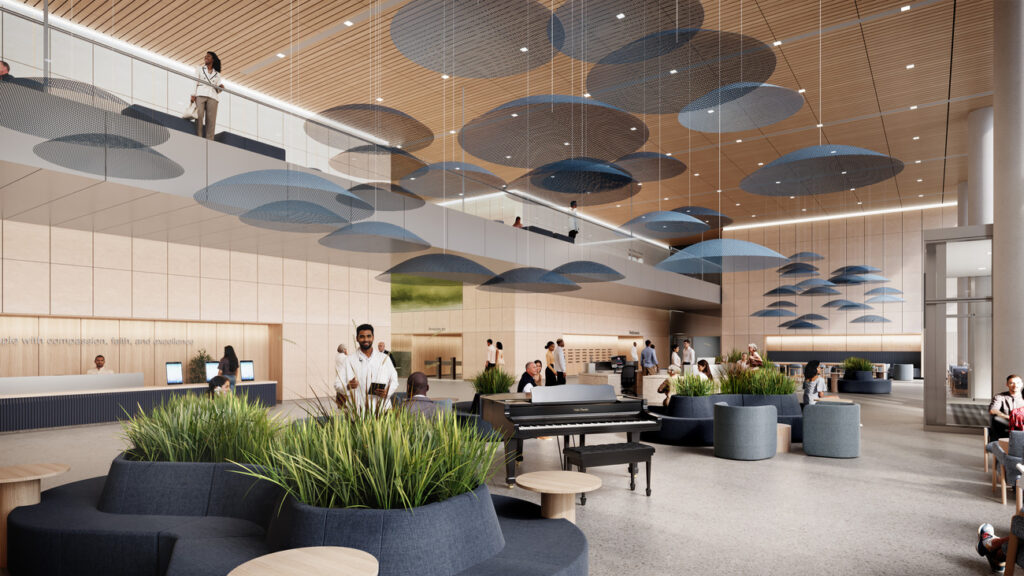
In a transitional area like the lobby, offering variety in seating and furniture configurations gives ownership back to visitors, allowing them to choose how they interact with the space.
“You might be waiting for a ride or visiting the grab-and-go market for a snack. You may be waiting on a loved one in surgery, but you need a place to work,” said Kingsbury.
For each of these purposes, the lobby provides a furniture choice. There are high-top tables for quiet work with convenience outlets for charging devices. Lounge seating along the windows offers a place for quiet reflection. Undulating sofas, alluding to the fluid movement of water in the tidal areas, fill the center of the lobby. Kingsbury explained that these modular sofas create a sense of privacy between visitors, because their organic shape removes feeling of sitting directly next to someone.
“We were looking for a way to create the subconscious feeling of a high-backed chair with privacy panels, without feeling so obtrusive,” she said.
The open space in the center of the modular sofas will be filled with greenery to soften the space and add a biophilic touch. In healthcare environments, where elements often feel hard-lined and focused mainly on durability and cleanability, providing relief to the clinical aesthetic is essential.
“Not every facility is open to the idea of live plants,” Kingsbury reflected, “but Roper utilizes greenery in several of their campuses for non-clinical areas, which further connects their spaces with the landscape.”
Patient Rooms Designed for Families
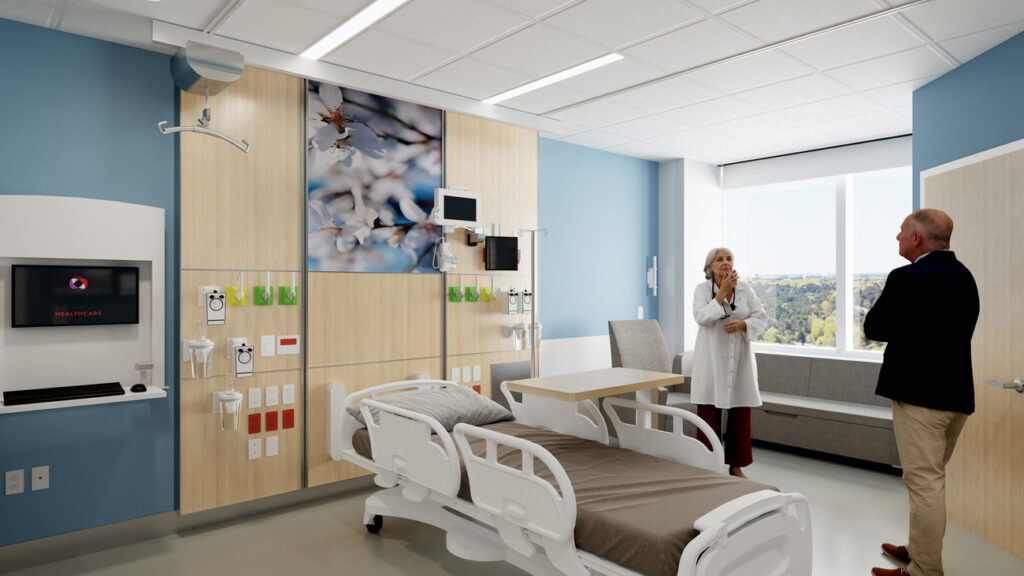
The typical patient room is broken into three zones: staff, patient, and family. Among these, patient space is dictated by codes for bed clearances and equipment, and staff space is designed for functionality and operations.
That’s why, when space is at a premium, the family zone is often the space that loses. To prevent this, the design team provided integrated storage space into the footwall for belongings, as well as a built-in bench for additional seating. Other amenities for families include working tables in the waiting areas, which provide visitors with quiet space without requiring them to leave the unit, and a sleeper sofa specifically selected for ease of use.
“The selection of the sleeper sofa is essential. If a user has difficulty operating the sleeper in a few steps, it’s not a viable option.” said Kingsbury.
Leading in Healthcare Technology Integration
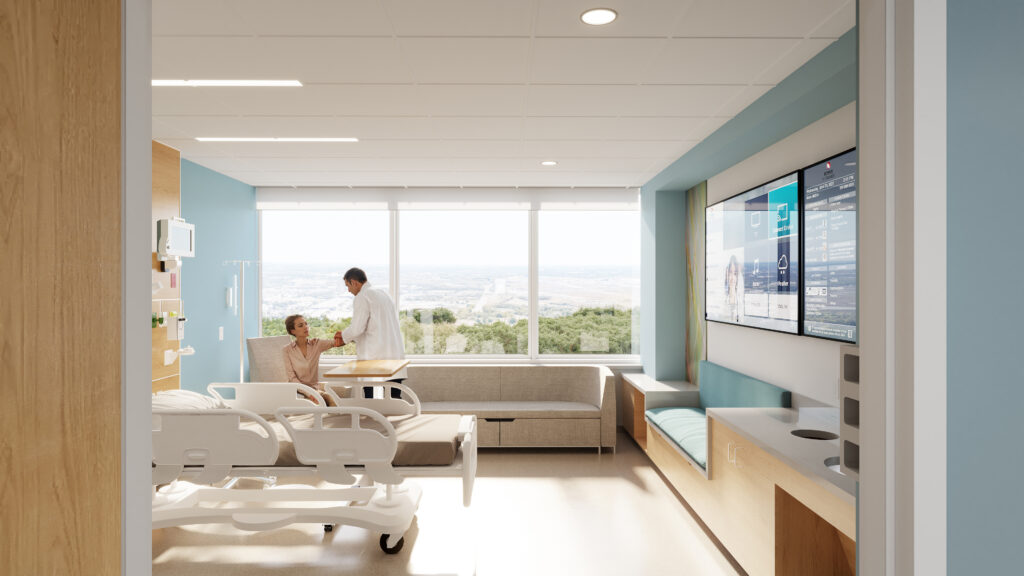
Patient rooms also incorporate an intelligent footwall monitoring system that promotes efficiency, safety, and comfort. The system facilitates telemedicine, observation, and displays virtual menus for the patient. Staff can enter and review crucial notes on the digital patient information board, a practice that traditionally takes place on a whiteboard. This all-in-one platform integrates vital aspects of care and facilitates the communication of patient information while remaining flexible for technological innovations to come.
Whether designing public amenity spaces or intense clinical units, arriving at solutions like those exhibited by Roper Hospital Medical Center are natural for E4H. We rely on our teams of experts and our wealth of experience to innovate solutions that are rooted in evidence and best practices while continuing to elevate aesthetic design.

Strategic Master Plan & Hospital Campus
E4H is partnering with Skidmore, Owings & Merrill (SOM) to...
Read More